How to Buy Less and Choose Better for Your Home
Buying less does not mean never buying anything for your home.
It means making fewer purchases that turn into clutter, duplicate something you already own, fail to fit the space, or solve a problem you did not really have.
A useful household product should earn the space, money, and maintenance it requires.
Before buying, evaluate seven things: Need → Fit → Function → Durability → Maintenance → Cost → Exit.
If your home already feels crowded, the best first step may be the decluttering plan. If the purchase is mainly about organization, review how to organize your home on a budget before adding more storage.
Key Takeaways
- Start with the problem, not the product.
- Measure the space and think through the routine before buying.
- Do not pay for features you are unlikely to use.
- Compare durability, upkeep, replacement cost, and storage footprint as well as price.
- Decide what the new item replaces so purchases do not simply accumulate.
Table of Contents
- Buying Less Is Not the Same as Buying the Cheapest
- 1. Need: What Problem Are You Actually Solving?
- 2. Fit: Does It Fit the Space and Your Routine?
- 3. Function: Will You Use the Features You Are Paying For?
- 4. Durability: How Long Does It Need to Last?
- 5. Maintenance: What Will It Cost to Own and Care For?
- 6. Cost: Compare Total Value, Not Just the Price Tag
- 7. Exit: What Happens to the Item It Replaces?
- Use a Pause Before Non-Urgent Purchases
- Smart Home Shopping Checklist
- Common Smart-Shopping Mistakes
- Frequently Asked Questions
Buying Less Is Not the Same as Buying the Cheapest
A low price can be good value, but it can also make a weak purchase easier to justify.
The goal of smart shopping is not to choose the cheapest version of everything. It is to buy the amount and quality that make sense for the actual job.
Sometimes the right answer is the budget option. Sometimes a more durable product used every day deserves more of the budget. Sometimes the best purchase is no purchase at all.
Use the seven-step framework below to make that decision before checkout.
1. Need: What Problem Are You Actually Solving?
A clear problem is the best defense against unnecessary purchases.
Instead of “I need a new organizer,” define what is failing: shoes are blocking the entryway, pan lids fall over in the cabinet, the vacuum has no convenient home, or the current laundry basket is broken.
Then ask whether a purchase is actually required. Decluttering, moving an item, changing a shelf height, or using something you already own may solve the same problem.
Quick Tip
Write the problem in one sentence before shopping.
If you cannot describe the problem without naming the product, you may be starting with the solution instead of the need.
2. Fit: Does It Fit the Space and Your Routine?
Household products have two kinds of fit: physical fit and routine fit.
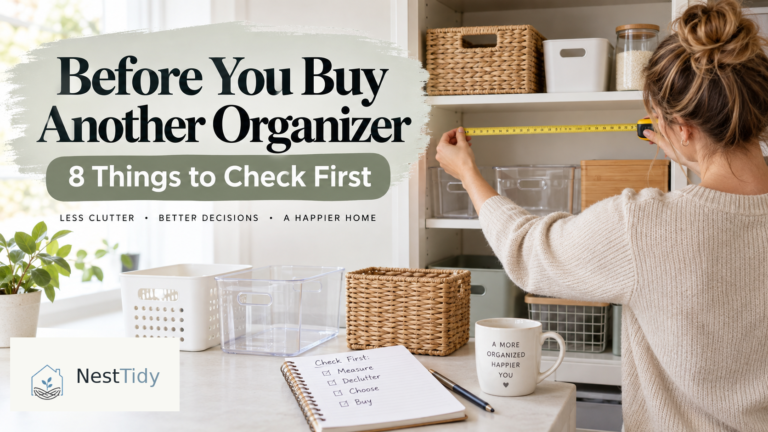
Physical fit is straightforward. Measure the width, depth, height, door clearance, and any obstacles in the area.
Routine fit asks whether the product belongs where the task actually happens. A beautiful basket across the room is a poor solution for something you need every morning.
The easier an item is to use and put away, the more likely the system is to last.
3. Function: Will You Use the Features You Are Paying For?
More features do not automatically create more value.
Ask which functions you will use regularly. A storage product may only need to stack safely and allow easy access. A small appliance may not need multiple specialty modes. A cleaning tool may not need a large accessory bundle.
Extra features can add cost, complexity, cleaning, storage, or replacement parts.
Choose the simplest product that handles the real job well.
4. Durability: How Long Does It Need to Last?
Durability matters most when an item is used frequently, carries weight, moves often, or would be inconvenient to replace.
For a low-use temporary category, the simplest affordable option may be enough. For a daily-use household item, stronger construction or replaceable parts may justify paying more.
Look beyond appearance. Consider materials, hinges, fasteners, weight limits when relevant, washable surfaces, warranty terms, and whether the design has obvious weak points.
Do not assume that higher price automatically means better durability. Compare the features that affect the actual use case.
5. Maintenance: What Will It Cost to Own and Care For?
The purchase price is only the first cost for some household products.
Consider filters, refills, proprietary bags, batteries, replacement pads, subscriptions, cleaning effort, spare parts, and the storage required for accessories.
A product that saves a few dollars upfront but requires expensive consumables may be a poor long-term value.
Maintenance also includes your time. If a product is difficult to clean or reset, you may stop using it even if it technically works.
6. Cost: Compare Total Value, Not Just the Price Tag
A useful comparison asks what you get for the money and how often you will benefit from it.
For similar products, compare the features that matter to your routine, not every feature listed on the box.
- purchase price
- expected frequency of use
- consumables or replacement parts
- maintenance requirements
- warranty or repairability when relevant
- space required to store the item
- whether it replaces something you already own
A higher price can be reasonable when the product is used constantly and a cheaper alternative repeatedly fails. A lower-cost option can be better when the use is occasional and the basic function is all you need.
7. Exit: What Happens to the Item It Replaces?
This is the step that prevents smart shopping from turning into gradual accumulation.
If the new item replaces an old one, decide what happens to the old one before the new purchase arrives.
Will it be donated, sold, recycled, repaired, moved to a genuinely useful second location, or disposed of appropriately?
Keeping the old item “just in case” can double the storage footprint without doubling the usefulness.
The exit question is especially important for kitchen tools, appliances, linens, furniture, storage bins, cleaning equipment, and electronics.
Use a Pause Before Non-Urgent Purchases
A short pause separates a real need from the excitement of finding a product.
You do not need an elaborate rule. For non-urgent purchases, leave the item in a list or cart long enough to check measurements, compare alternatives, and see whether the problem still feels important.
The point is not to create friction around every necessary purchase. It is to create enough space for the decision to become deliberate.
Smart Home Shopping Checklist
Need
- What exact problem am I solving?
- Can I solve it by decluttering, repairing, moving, borrowing, or reusing something I own?
- How often does this problem actually occur?
Fit
- What are the exact dimensions of the space?
- Will doors, drawers, appliances, or walkways still work?
- Does the product live where the routine happens?
Function and Durability
- Which features will I actually use?
- What materials or components affect durability?
- Is the simplest version enough for the job?
Maintenance and Cost
- Does it require refills, filters, subscriptions, batteries, or proprietary parts?
- How easy is it to clean and maintain?
- Am I comparing total value rather than only the sale price?
Exit
- What does this purchase replace?
- What will happen to the old item?
- Where will the new item be stored when it is not in use?
Common Smart-Shopping Mistakes
1. Starting With a Product Instead of a Problem
Seeing an organizer or gadget first can make you invent a reason to own it.
2. Buying Because It Is on Sale
A discount only saves money when the item was useful enough to buy in the first place.
3. Ignoring Dimensions
Household products frequently fail because they fit the category but not the actual shelf, drawer, doorway, or routine.
4. Paying for Features You Will Not Use
More modes, accessories, compartments, and functions can add cost and complexity without improving daily use.
5. Comparing Price Without Maintenance
Consumables, subscriptions, filters, cleaning effort, and replacement parts can change the real cost.
6. Keeping the Old Version Automatically
A replacement purchase should usually trigger an exit decision for the item it replaces.
7. Buying Multiples Before Testing One
One organizer may work beautifully in theory and poorly in your actual home. Test before scaling the purchase.
Frequently Asked Questions
How can I stop buying things I do not need for my home?
Start by defining the problem before looking at products. Use a short pause for non-urgent purchases, check what you already own, and decide where the item will live and what it will replace.
Is it better to buy cheap or pay more for household products?
It depends on the use case. A budget option can be excellent for occasional or simple needs, while a frequently used product may justify paying more for durability, repairability, or easier maintenance. Compare the features that matter to your routine.
What should I check before buying an organizer?
Measure the exact space, identify what the organizer will hold, check access and clearance, consider how easy it is to clean or reset, and make sure the category is already decluttered.
How do I know if a home product is worth buying?
A product is easier to justify when it solves a recurring problem, fits the space and routine, performs the needed function reliably, has acceptable ongoing costs, and replaces or improves something you already use.
Should I wait before making a household purchase?
For non-urgent purchases, a short pause can help you check measurements, compare alternatives, and decide whether the need is real. Urgent safety, repair, or essential replacement purchases may not require the same delay.
How do I compare value for money between two products?
Compare the functions you will actually use, durability, maintenance, ongoing costs, warranty or repair considerations when relevant, storage footprint, and how often you expect to use the product—not just the sticker price.
Let the Purchase Earn Its Place
Every household item uses more than money. It uses space, attention, cleaning, maintenance, and eventually an exit decision.
That does not make buying bad. It makes choosing well valuable.
Start with the need. Check the fit. Choose the function you will use. Consider durability and maintenance. Compare the real cost. Decide what leaves.
When a purchase passes those checks, it is much more likely to make the home work better instead of simply adding another thing to manage.