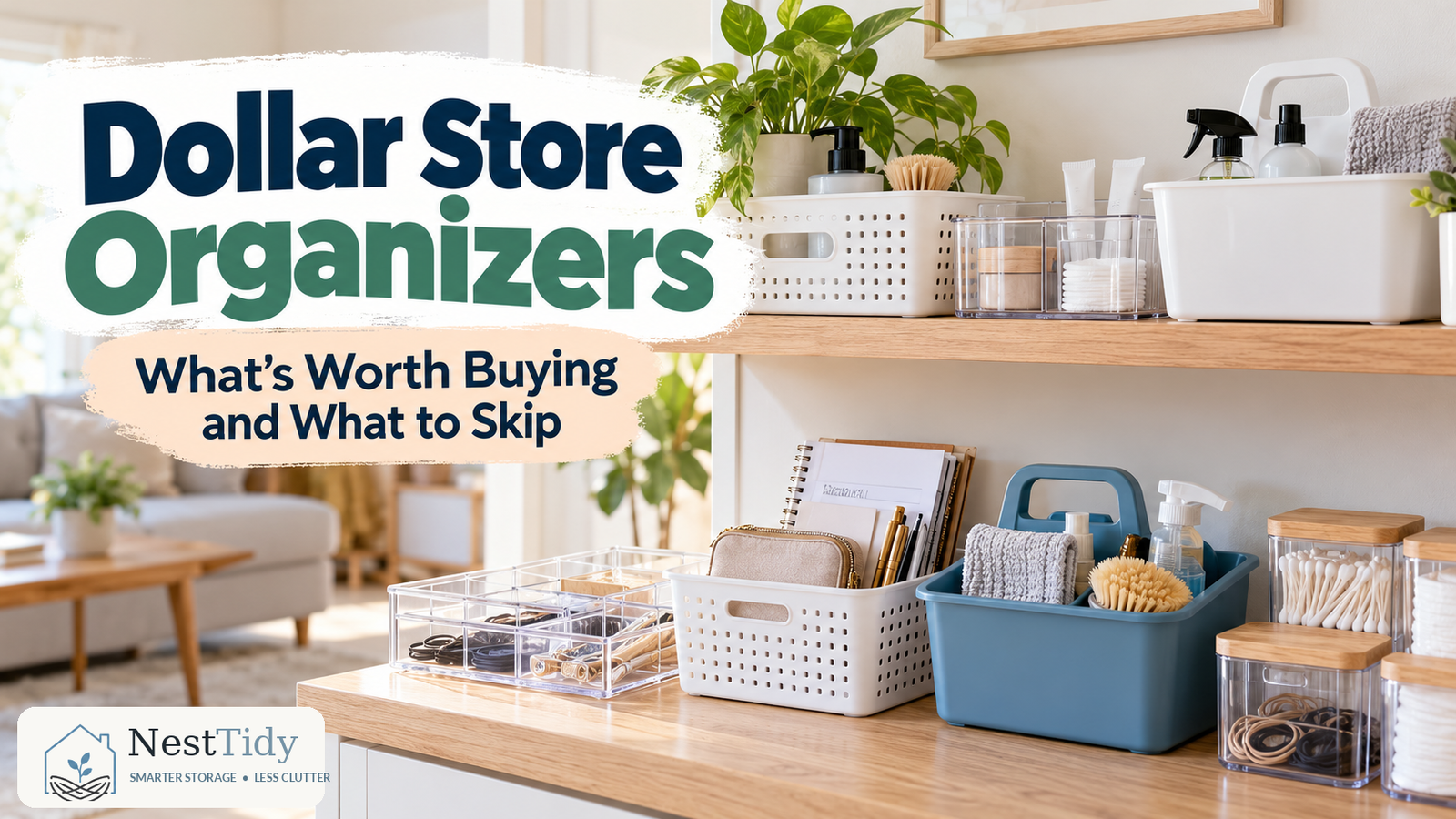
Dollar Store Organizers: What’s Worth Buying and What to Skip
Dollar store organizers can feel like an easy win. They are inexpensive, easy to grab, and often look like a low-risk way to get more organized. A few trays, bins, baskets, or caddies can seem like a smart shortcut, especially when you are trying to tidy up without spending much.
Sometimes that works. Sometimes it does not.
A cheap organizer is only a good deal if it actually helps you use the space better, keeps things easier to find, and holds up well enough for the job. If it cracks quickly, wastes space, or adds another layer of clutter, even a low price is not really a bargain.
This guide breaks down which dollar store organizers are usually worth buying, which ones deserve more caution, and how to make better low-budget storage decisions without filling your home with things that do not help.
Key Takeaways
- Cheap organizers can be useful when the problem is simple and the category is light.
- Low price does not automatically mean good value.
- Small trays, baskets, and caddies are often the safest buys.
- Flimsy, awkward, or overly specific organizers are more likely to disappoint.
- Measure the space and decide exactly what the organizer will hold before buying.
- A cheap organizer is best when it helps you test or improve a system, not create one from scratch.
Why Dollar Store Organizers Can Be a Great Deal or a Waste of Money
Dollar store organizers sit in an interesting middle ground. On one hand, they can be perfect for small projects:
- Separating drawer items
- Grouping pantry packets
- Holding bathroom supplies
- Containing craft items
- Testing whether a storage idea actually works
On the other hand, they can be frustrating when:
- The plastic is too flimsy
- The shape wastes usable space
- The organizer is too small for the job
- The handles break easily
- It only looks useful in the store
- You buy it before deciding what problem it is supposed to solve
That is the main rule behind this entire article: Cheap is only a good deal if it actually works.
Quick Answer: What Is Usually Worth Buying?
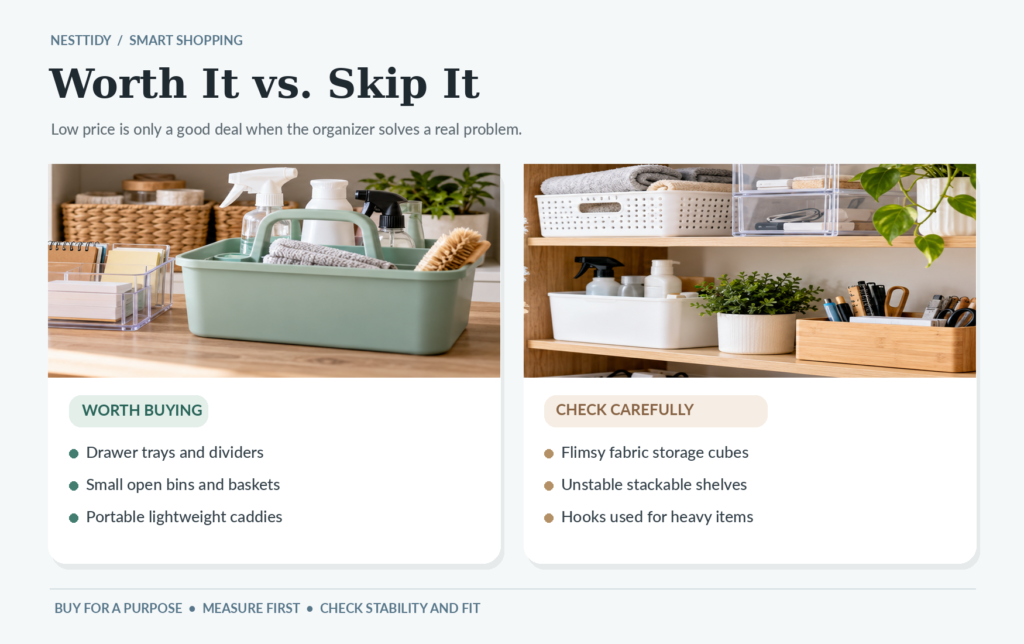
In general, the best dollar store organizers are the simplest ones. That usually includes:
- Drawer trays
- Small open bins
- Plastic baskets
- Caddies
- Simple containers for light categories
- Basic file holders
- Small organizers for desk, craft, or bathroom use
The products that need more caution are usually flimsy fabric cubes, weak shelving, unstable stackable pieces, hooks used beyond their safe load, awkwardly shaped containers, and sets bought without a plan.
Buy simple, light-duty organizers for small categories. Be careful with anything that needs strength, stability, or a perfect fit.
What to Check Before Buying Any Cheap Organizer
Before looking at product types, slow down and check a few basics. Ask yourself:
- What exactly will this hold?
- Where will it go?
- Have I measured the space?
- Is this for daily use or occasional storage?
- Will it still be easy to use once it is full?
- Am I buying this because I need it, or because it feels like progress?
A dollar store organizer is still clutter if it has no job. That is why even a low-cost item should solve a clear problem.
Worth Buying: Simple Drawer Trays and Dividers
Drawer trays are one of the safest cheap-organization purchases. They solve a straightforward problem: small items sliding around in a drawer.
They can be useful for office supplies, makeup, bathroom tools, kitchen gadgets, utensils in low-use drawers, junk-drawer categories, charging cables, and small electronics.
What makes them worth buying is their simplicity. They do not need to be beautiful or especially strong to be useful. Just make sure the size makes sense for your drawer and the items inside.
Usually worth it when: you need basic separation for lightweight items.
Skip if: the tray wastes too much drawer space or the compartments are too small to be useful.
Worth Buying: Small Plastic Baskets and Open Bins
This is one of the most versatile categories. Small plastic baskets and open bins can help group items in pantries, bathroom cabinets, under-sink storage, linen closets, kids’ areas, cleaning supply zones, and craft storage.
They are especially helpful when the goal is simply to keep similar items together. Open bins also reduce friction. You can usually grab what you need quickly without opening a lid or unstacking several containers.
Usually worth it when: you need to contain small categories or stop things from spreading across a shelf.
Skip if: the bin is too flimsy for the weight of the category or its shape wastes more space than it saves.
Worth Buying: Portable Storage Caddies
Small caddies can be a smart dollar store buy because they create grab-and-go storage. Good uses include cleaning supplies, art supplies, kids’ homework tools, basic toiletries, hair accessories, and simple under-sink categories.
A caddy is useful when you need to move a category from one place to another or keep a small routine contained in one spot. For example, a bathroom caddy can hold the items you use every morning, while a cleaning caddy can keep light all-purpose supplies together.
Usually worth it when: portability matters and the items are not too heavy.
Skip if: the handle feels weak or the caddy becomes awkward once filled.
Worth Buying: Lightweight Desktop and Craft Organizers
Dollar stores often carry small plastic organizers that can work well for pens, markers, scissors, sticky notes, craft tools, beads, buttons, skincare samples, and small accessories.
This is a category where cheap organizers can make sense because the items are light and the risk is low. You do not need premium materials to hold paper clips.
Usually worth it when: the organizer is simple and the category is lightweight.
Skip if: the organizer has too many tiny compartments you will not actually use.
Worth Buying: Basic File Holders and Small Storage Containers
Simple file holders can be surprisingly useful outside of paperwork. Depending on size and sturdiness, they may organize cutting boards, wraps and foils, magazines, notebooks, mail, coloring books, or other flat items.
Small lidded or unlidded containers can also work well when you already know exactly what should go inside. The key is clarity of purpose; these items are best when they solve a narrow problem.
Usually worth it when: you need an inexpensive structure for flat items or small contained categories.
Skip if: you are buying them just because they look useful but do not have a clear use.
What to Skip or Inspect Carefully: Flimsy Fabric Storage Cubes
Fabric cubes can look tidy, but this is one of the categories where quality matters more. Cheap versions may sag, lose their shape, collapse when not full, wear out at the seams, or look messy faster than expected.
That does not mean every low-cost fabric cube is useless. It means this category deserves more caution than a simple plastic tray. If you want cubes for visible shelving in a main living space, a sturdier version may be worth paying more for.
Be careful when: appearance, structure, or frequent handling matters.
What to Skip or Inspect Carefully: Weak Shelves and Unstable Stackable Organizers
Cheap stackable shelves, mini risers, or light shelf systems may look like a quick fix, but they can create frustration if they wobble, bow, or shift easily. That is especially true around heavy canned goods, cleaning products, dishes, and other weighty items.
The more weight a product has to support, the more cautiously you should evaluate a very low-cost version. Follow any stated load limits and use instructions; do not assume a small riser is safe for heavy items.
Be careful when: the organizer has to support real weight or remain stable during daily use.
What to Skip or Inspect Carefully: Hooks and Suction-Cup Storage for Heavy Items
Hooks can be useful, but not all hooks are equal. Low-cost adhesive hooks or suction-cup organizers may work for lightweight keys, small accessories, or a single hand towel when installed according to instructions.
They may be much less reliable for heavy bags, bulky jackets, wet bath items, or anything that is pulled on frequently. Check the manufacturer’s surface and weight guidance. For heavy loads, a properly installed and rated alternative is the safer choice.
Be careful when: the hook is doing real work, not just holding something very light.
What to Skip or Inspect Carefully: Food Containers Without a Clear Plan
Food containers can be tempting, especially when you see matching shapes at a low price. But they become clutter if lids do not seal well, sizes are random, the shapes stack awkwardly, or you already own more than you use.
If a container will touch food, check that it is labeled as suitable for food contact and for the intended use. Do not assume it is microwave-, dishwasher-, or freezer-safe unless the labeling says so.
This does not make all inexpensive containers bad purchases. It just means they are not a great “just in case” buy.
Be careful when: the container needs to last, stack neatly, seal properly, or be used with food.
What to Skip or Inspect Carefully: Bulk Sets and Baskets You Have No Plan For
This is one of the most common shopping mistakes. You see several matching baskets, they seem useful, and you buy them because they look like they will help later.
But a product without a job often becomes part of the clutter. Cheap organizing does not mean buying more random containers. It means buying a low-cost solution after identifying a problem.
Be careful when: the main reason for buying something is “I might use this someday.”
When Is a More Expensive Organizer Actually Worth It?
Sometimes spending more really does make sense. That is usually true when the organizer needs to provide:
- Durability
- Better fit
- Daily convenience
- Structural support
- Strong hardware
- Long-term visibility in a main living space
A better-quality option may be sensible for a shoe cabinet, pull-out drawer system, heavy-duty pantry organizer, moisture-exposed bathroom storage, load-bearing shelf, or visible storage piece you want to keep for years.
The point is not that expensive is always better. It is that price matters less than function, durability, and fit. A cheap tray can be excellent. A cheap load-bearing shelf may not be.
The 5-Question Dollar Store Buying Checklist
1. What problem is this solving?
If you cannot answer clearly, leave it.
2. What will go inside?
A vague idea is not enough. Know the category.
3. Will it fit the space and the items?
Measure first whenever size matters.
4. Is the product strong enough for the job?
Think honestly about weight, frequency of use, stability, and handling.
5. Am I buying this because it is useful, or because it is cheap?
This question alone can save you from a lot of clutter.
Frequently Asked Questions
Are dollar store organizers worth it?
They can be. Simple organizers for small, lightweight categories are often good value. Products that need strength, durability, or a precise fit require more caution.
What should I buy at a dollar store for organizing?
Drawer trays, small open bins, caddies, simple baskets, and basic desk or bathroom organizers are often useful options when they match a real need.
What should I avoid buying at a dollar store for storage?
Be cautious with flimsy fabric cubes, weak shelves, unstable stackable organizers, hooks meant for heavy items, and random containers with no clear purpose.
Are dollar store bins good for pantry organization?
They can be, especially for lightweight snacks, packets, or grouped shelf categories. Make sure they fit the shelf and are sturdy enough. For direct food contact, use appropriately labeled containers.
Is cheap organizing always better for a small budget?
Not necessarily. A cheap organizer that breaks or does not work is wasted money. Sometimes using what you already have, or buying one better item, is the smarter choice.
Should I buy matching organizers from the dollar store?
Only if they fit your actual space and categories. Matching storage is not necessary for a functional home.
Take the Next Useful Step
If this helped you think more carefully about cheap organizers, the next useful step is to explore practical ways to organize without unnecessary purchases:
Read How to Organize Your Kitchen on a Budget Without Buying More Stuff or How to Create Free Storage Using Things You Already Have.
Good organizing is not about buying the most storage. It is about buying only what helps.
Final Thought
Dollar store organizers can absolutely have a place in a practical home. Some are smart, simple, and useful. Others only feel like a bargain because the price is low.
The best approach is not to ask whether something is cheap. It is to ask whether it fits your space, solves a real problem, and makes daily life easier.
If the answer is yes, it may be worth buying. If not, even a small price can be too much.