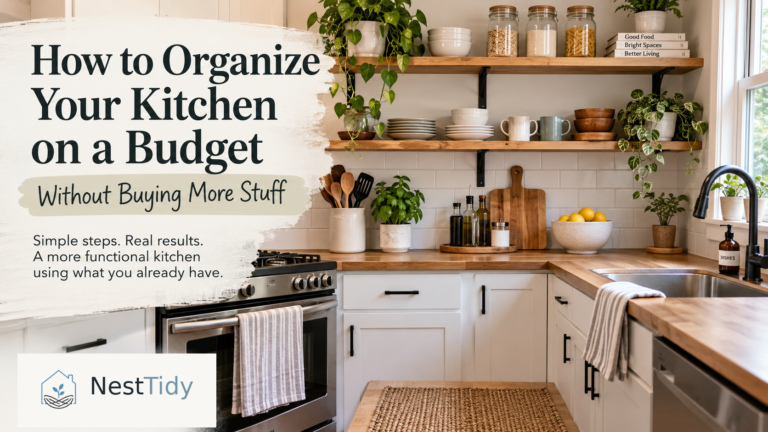
How to Organize Your Home on a Budget Without Buying Everything New
Home organization can become surprisingly expensive when the first step is shopping.
Matching bins, drawer inserts, baskets, labels, shelving systems, and storage furniture can look useful before you know whether you actually need them.
A better budget approach is to reduce what you are storing, use the space and containers you already own, and spend only when a specific purchase makes the home easier to use.
The goal is not to organize your home for free at all costs. It is to make every dollar solve a real problem.
If the amount of stuff is the main issue, begin with our simple decluttering plan or use the room-by-room decluttering checklist before buying storage.
Key Takeaways
- Decluttering usually creates more useful space than buying another container.
- Reuse boxes, baskets, jars, trays, and bins you already own when they fit the job.
- Organize around routines and categories before trying to make everything match.
- Spend money only when a product improves access, safety, durability, or daily convenience.
- Measure the space and the category before buying any organizer.
Table of Contents
- Budget Organization Starts Before Shopping
- 1. Declutter Before You Spend
- 2. Shop Your Home First
- 3. Define the Storage Problem Before the Product
- 4. Create Simple Zones With What You Already Own
- 5. Reuse Containers Without Creating Visual Chaos
- 6. Spend Only Where Function Improves
- 7. Measure Before Buying Any Organizer
- 8. Avoid Cheap Purchases That Become New Clutter
- Room-by-Room Budget Organization Plan
- Budget Home Organization Checklist
- Common Budget Organization Mistakes
- Frequently Asked Questions
Budget Organization Starts Before Shopping
A storage product is not the same thing as an organization system.
A system answers practical questions: What belongs here? How much of it fits? Who uses it? How easy is it to put away? What happens when the category grows?
A basket can support that system, but the basket itself cannot make those decisions for you.
For a budget-friendly home, do the thinking first and the purchasing last.
1. Declutter Before You Spend
The less you need to store, the fewer organizing products you need to buy.
Start with obvious trash, expired items, duplicates, broken things you will not repair, unused products, and items that no longer belong in your current life.
Then put the remaining items back into the existing space before deciding whether storage is actually inadequate.
Quick Tip
Do not buy storage for items that may be leaving.
Finish the decluttering decision first. Buying containers too early often means spending money to store things you later decide you do not want.
2. Shop Your Home First
Before opening a shopping app, walk through your own home.
Look for unused baskets, small boxes, jars, trays, bins, hooks, drawer organizers, shelf risers, magazine holders, shoe boxes, and containers that are currently empty or serving a low-priority purpose.
A shallow tray can become an entryway catchall. A small box can separate cables in a drawer. A basket can group cleaning supplies. A sturdy shoe box can hold seasonal accessories.
The item does not need to look like an organizer. It needs to fit the category and the space.
3. Define the Storage Problem Before the Product
Avoid vague problems such as “this closet needs organizing.”
Make the problem specific: shoes are blocking the floor, small accessories disappear on the shelf, cleaning bottles fall over, or paperwork has no action zone.
Once the problem is specific, the cheapest solution often becomes obvious. Sometimes the answer is a box you already own, a different shelf position, a hook, a smaller category, or simply moving the items closer to where they are used.
4. Create Simple Zones With What You Already Own
Zones reduce the need for complicated storage because related items stay together.
- an entry zone for keys, sunglasses, and outgoing items
- a cleaning zone for the supplies used in one part of the home
- a breakfast or coffee zone in the kitchen
- a bedtime zone for a book, charger, glasses, or medication
- a paperwork action zone for bills, forms, and documents that require follow-up
Use a shelf section, drawer, basket, tray, or simple container as the physical boundary. The boundary matters more than whether every container matches.
5. Reuse Containers Without Creating Visual Chaos
Reusing what you own saves money, but random containers can become frustrating if they are difficult to stack, too deep for the category, or visually overwhelming in an open room.
Use mismatched containers freely inside drawers, closets, cabinets, garages, and other closed storage when they work well.
For highly visible areas, simplify the number of container types rather than replacing everything at once. You may already own two or three baskets that can be grouped together.
Function comes first. Visual consistency is useful only when it helps the space feel calmer or easier to understand.
6. Spend Only Where Function Improves
Some purchases are worth making. The key is knowing what the money is buying you.
A product may be worth considering when it improves access to a deep cabinet, adds safe vertical storage, protects important items, makes a difficult category easier to reset, or replaces a temporary solution that keeps failing.
A decorative bin that simply hides an oversized category is less likely to solve the underlying problem.
A Purchase Is Easier to Justify When It
- solves a clearly defined storage problem
- fits the exact dimensions of the space
- makes an everyday routine easier
- replaces a broken or frustrating temporary solution
- can be cleaned or maintained easily
- works with the amount you realistically plan to keep
7. Measure Before Buying Any Organizer
Cheap storage is still wasted money if it does not fit.
Measure width, depth, and usable height. Check doors, hinges, shelf lips, pipes, baseboards, and handles that reduce the real opening.
Measure the items too. A bin may fit a shelf and still be too shallow for the category or too deep to access comfortably.
Write the measurements down before shopping. Do not rely on remembering them while looking at products.
8. Avoid Cheap Purchases That Become New Clutter
Low price can make an organizing product feel low-risk, but several unnecessary small purchases can cost more than one well-chosen solution.
Avoid buying a bin, basket, hook, label set, or drawer insert simply because it is on sale or looks useful.
Ask where it will go, what it will hold, what problem it solves, and what you are using there now.
If those answers are vague, wait.
Room-by-Room Budget Organization Plan
Kitchen
- declutter duplicates and rarely used gadgets before adding storage
- adjust shelf heights before buying shelf risers
- reuse jars or small boxes inside drawers when they fit
- move occasional serving pieces out of prime kitchen storage
- use the ideas in Small Kitchen Storage Ideas That Don’t Waste Counter Space before adding countertop storage
Bathroom
- discard expired or empty products first
- group daily-use items separately from backups
- reuse small trays or boxes inside drawers
- avoid buying deep bins that hide small products
Closet
- reduce clothing volume before adding shelves or hanging products
- use existing boxes for seasonal accessories
- keep frequently worn items in the easiest-to-reach area
- repurpose sturdy baskets before buying matching sets
Entryway
- limit the zone to items needed when leaving or arriving
- use an existing bowl or tray for keys
- reuse hooks if you already own them
- avoid adding furniture if a smaller wall or drawer solution works
Living Room
- remove categories that belong in another room
- use existing closed furniture before adding decorative baskets
- limit blankets, magazines, and remote controls to physical boundaries
- keep visible storage simple so the room does not feel busier
Budget Home Organization Checklist
Before Spending
- Declutter the category.
- Put back what is staying.
- Shop your home for usable containers.
- Define the exact storage problem.
- Try a no-cost layout change first.
- Measure the space and the category.
Before Buying
- Know exactly where the product will go.
- Confirm the dimensions.
- Decide what it will hold.
- Check whether it improves access or daily use.
- Compare the purchase with a solution you already own.
- Avoid buying multiples until one unit proves useful.
Common Budget Organization Mistakes
1. Buying Matching Containers Before Decluttering
You may end up buying storage for items that should leave the home.
2. Treating Dollar Amount as the Only Measure of Value
A very cheap organizer that does not fit, breaks quickly, or creates more friction is not a bargain.
3. Reusing Containers That Do Not Fit the Job
Free is not useful when a box hides the category or wastes most of a shelf.
4. Organizing for Appearance Instead of Routine
A beautiful system that takes too many steps to reset will be difficult to maintain.
5. Buying Multiples Immediately
Test one organizer in the real space before buying an entire matching set.
6. Ignoring Measurements
A product can be inexpensive and still be a complete waste if the door will not close or the category does not fit.
7. Adding Storage Instead of Setting a Limit
Sometimes the budget solution is to keep fewer items within the space you already have.
Frequently Asked Questions
Can I organize my home without buying storage containers?
Yes. Start by decluttering, grouping items by category, changing shelf positions, reusing containers you already own, and moving items closer to where they are used. Buy storage only when a specific problem remains.
What household items can I reuse for organization?
Sturdy boxes, jars, trays, baskets, shoe boxes, small containers, magazine holders, and unused drawer organizers can all work when their size and shape fit the category.
Where should I spend money when organizing on a budget?
Prioritize purchases that improve access, safety, durability, or an everyday routine. A product that solves a recurring problem is usually more valuable than one purchased mainly for appearance.
Should all my storage bins match?
No. Matching containers can make visible storage look calmer, but function matters more. In drawers, closets, and cabinets, mismatched containers can work perfectly well if they fit the space and category.
How do I avoid wasting money on organizers?
Declutter first, define the exact problem, measure the space and items, test a low-cost or existing solution, and avoid buying multiples until you know the product works.
What is the cheapest way to make a room feel more organized?
Reduce visible clutter, return misplaced items, group related items, clear the most useful surfaces, and give common categories simple physical boundaries using what you already own.
A Better Budget Starts With Fewer Purchases
Organizing on a budget is not about refusing to spend money.
It is about making sure the purchase comes after the problem is understood.
Declutter first. Reuse what works. Measure what remains. Then spend where the improvement will be obvious in daily life.
That approach usually creates a home that is easier to manage and a shopping list that is much shorter.