Small Home Organization Ideas That Make the Most of Limited Space
A small home can feel crowded long before it is actually full.
The problem is often not the square footage alone. It is the way everyday items compete for the same shelves, surfaces, drawers, and walkways.
The useful question is not, “Where can I fit another storage bin?” It is, “How can this space do its job with less friction?”
Good small-home organization starts by reducing what does not need to be there, giving important categories clear boundaries, and using overlooked space without making every wall and surface look busy.
You do not need a showroom-perfect apartment or a collection of matching organizers. You need a system that makes the home easier to use on an ordinary Tuesday.
Key Takeaways
- Declutter before adding more storage so you are organizing what you actually use.
- Build storage around daily routines instead of filling every available inch.
- Use vertical and hidden space selectively, especially when floor space is limited.
- Keep frequently used items easy to reach and less-used items out of prime storage zones.
- Choose organization systems that are easy to reset, not just attractive when freshly arranged.
Table of Contents
- Start With Function, Not Storage Products
- 1. Reduce the Volume Before You Add Storage
- 2. Create Small Zones Around Real Routines
- 3. Use Vertical Space Intentionally
- 4. Use Overlooked Space Before Adding Furniture
- 5. Protect Your Most Useful Surfaces
- 6. Choose Storage That Does More Than One Job
- 7. Keep Everyday Items Easy to Reach
- 8. Give Categories Physical Limits
- 9. Make Storage Visually Quieter
- 10. Favor Flexible, Renter-Friendly Systems
- Small-Space Organization Ideas by Room
- Small-Home Organization Checklist
- Common Small-Space Organization Mistakes
- Frequently Asked Questions
Start With Function, Not Storage Products
Small spaces punish storage decisions that are made without a clear purpose. A shelf, cart, basket, or cabinet may technically fit and still make the room harder to use.
Before changing anything, identify the pressure point. Is the entryway collecting shoes? Is the kitchen counter covered because small appliances have nowhere else to go? Is the bathroom cabinet deep but difficult to access? Is the bedroom short on closed storage?
Once you know the actual problem, you can choose a solution that improves the routine instead of simply adding another object to the room.
A useful small-space system should make at least one of these things easier: finding an item, putting it away, keeping a surface clear, using a walkway, or resetting the room quickly.
1. Reduce the Volume Before You Add Storage
The fastest way to create more usable space is often to reduce the amount that needs to be stored.
Look first for obvious excess: duplicates, expired products, unused gadgets, damaged items, old paperwork, clothes that no longer fit your life, and containers that are empty but still taking up space.
Do this before measuring for bins or buying shelving. Once the volume drops, the storage problem may become much smaller.
This is especially important in compact kitchens and closets. Adding another organizer to a cabinet that already contains too much can make access worse, not better.
Quick Tip
Leave some storage capacity unused.
If every shelf and drawer is packed to the edge, normal life has nowhere to go. A little breathing room makes it easier to put things away and notice when a category is growing too large.
2. Create Small Zones Around Real Routines
A zone is simply a small area where the items needed for one routine live together.
For example, a coffee zone might contain the coffee maker, filters, mugs, and coffee. A leaving-the-house zone near the door might hold keys, a wallet, sunglasses, and a bag. A bedtime zone might keep a charger, book, glasses, and medication together.
Zones reduce the number of places you need to search and the number of steps required to put things away.
In a small home, keep zones compact. One routine does not need to expand across an entire cabinet or wall. Give it the smallest amount of space that works comfortably.
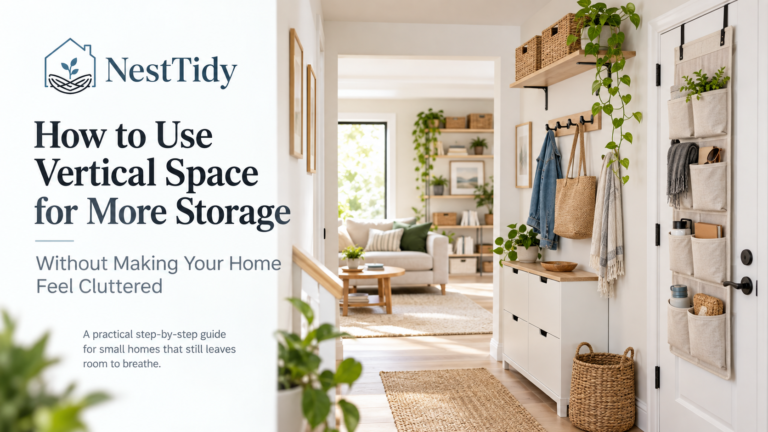
3. Use Vertical Space Intentionally
When floor space is limited, walls, cabinet height, doors, and the upper part of closets can become useful storage areas.
Examples include a second shelf inside a tall cabinet, hooks behind a door, a narrow wall-mounted rail, stackable drawers, or an additional closet shelf above the main hanging area.
But vertical storage is not automatically better. If every wall is covered with hooks, racks, open shelves, and hanging organizers, the room can start to feel visually crowded.
Use vertical space for categories that benefit from it, and leave some wall area visually quiet.
4. Use Overlooked Space Before Adding Furniture
Before buying another cabinet or bookcase, check the spaces that already exist.
- under the bed for low-frequency items in suitable containers
- the back of closet or pantry doors for light, frequently used items
- the upper shelf of a closet for seasonal or occasional categories
- the inside of cabinet doors when the hardware does not interfere with closing
- narrow gaps that may fit a slim rolling cart only if it can move freely
- the space beneath a sink, organized around pipes rather than against them
The goal is not to fill every hidden cavity. It is to use the best overlooked spaces before taking more floor area away from the room.
5. Protect Your Most Useful Surfaces
Countertops, tables, desks, and the tops of dressers are easy places to set things down. In a small home, that makes them some of the most valuable spaces to protect.
Try to separate storage from work surfaces. A kitchen counter should leave enough room for food preparation. A desk should leave enough room to work. An entry console should not become permanent storage for every object entering the home.
If the same objects repeatedly land on a surface, give those objects a nearby home. The solution is usually a better drop zone, not a stricter rule about never putting anything down.
6. Choose Storage That Does More Than One Job
In limited space, a storage piece earns its footprint when it solves more than one problem.
A bench can provide seating and shoe storage. A bed with drawers can replace separate under-bed boxes. A narrow cart can move between tasks instead of becoming a permanent obstacle. An ottoman with storage can hold blankets while still serving as seating or a footrest.
Do not buy multi-purpose furniture just because it has hidden storage. The primary function still needs to work well. A storage bench that blocks a walkway is not a space-saving solution.
7. Keep Everyday Items Easy to Reach
Prime storage space should go to the things you use most often.
Daily dishes belong where they are easy to reach. A frequently worn jacket should not be behind a box of seasonal decorations. Toilet paper should not require moving three baskets. A charger used every night should not live in a distant utility drawer.
Move low-frequency categories higher, deeper, or farther away. Keep daily-use categories between roughly waist and eye level whenever the room allows it.
The less effort it takes to return an item, the more likely the system is to stay organized.
8. Give Categories Physical Limits
Small homes work better when categories have clear boundaries.
Instead of allowing reusable bags, cleaning products, mugs, towels, or hobby supplies to expand indefinitely, decide where each category lives.
The container, drawer, shelf, or cabinet becomes the limit. When the category no longer fits comfortably, reassess the contents before expanding the storage.
This keeps organization from turning into a continuous search for more places to put more things.
9. Make Storage Visually Quieter
Open storage can be practical, but a large amount of visible stuff makes a compact room feel busier.
Use closed storage for visually mixed categories when possible. On open shelves, group similar items and leave some empty space rather than filling every inch.
You do not need matching containers everywhere. Consistency can come from repeating a few simple choices: similar basket sizes, a limited number of materials, or clear categories instead of decorative labels on everything.
The goal is calm enough to live with, not a perfectly styled photo.
10. Favor Flexible, Renter-Friendly Systems
If you rent or expect to move, flexibility matters as much as storage capacity.
Free-standing shelves, tension-based solutions used within their safe limits, over-the-door organizers, removable hooks appropriate for the surface, modular drawers, and bins that can move between rooms are easier to reuse than highly customized built-ins.
Measure first, follow the manufacturer’s installation limits, and avoid loading temporary mounting systems beyond what they are designed to hold.
A flexible system is also useful for homeowners because household needs change. Storage that can move or be reconfigured often lasts longer than a solution designed for one exact category.
Small-Space Organization Ideas by Room
Kitchen
- Keep counters focused on the few appliances or tools used most often.
- Add shelf risers only where cabinet height is being wasted.
- Store food and tools by task: breakfast, coffee, baking, lunch packing, or cooking.
- Use cabinet doors or narrow pullouts only when they improve access instead of blocking it.
Bathroom
- Keep daily toiletries in the easiest-to-reach zone and backups farther away.
- Use the vertical space above the toilet only if it does not make the room feel crowded.
- Organize under-sink storage around plumbing and keep frequently used items visible.
- Avoid storing large quantities of products simply because they were purchased in bulk.
Bedroom and Closet
- Separate everyday clothing from seasonal, formal, or keepsake clothing.
- Use the upper closet area for low-frequency categories.
- Consider under-bed storage for items you need occasionally, not for forgotten clutter.
- Keep a clear path around the bed; extra storage is not useful if it makes the room harder to move through.
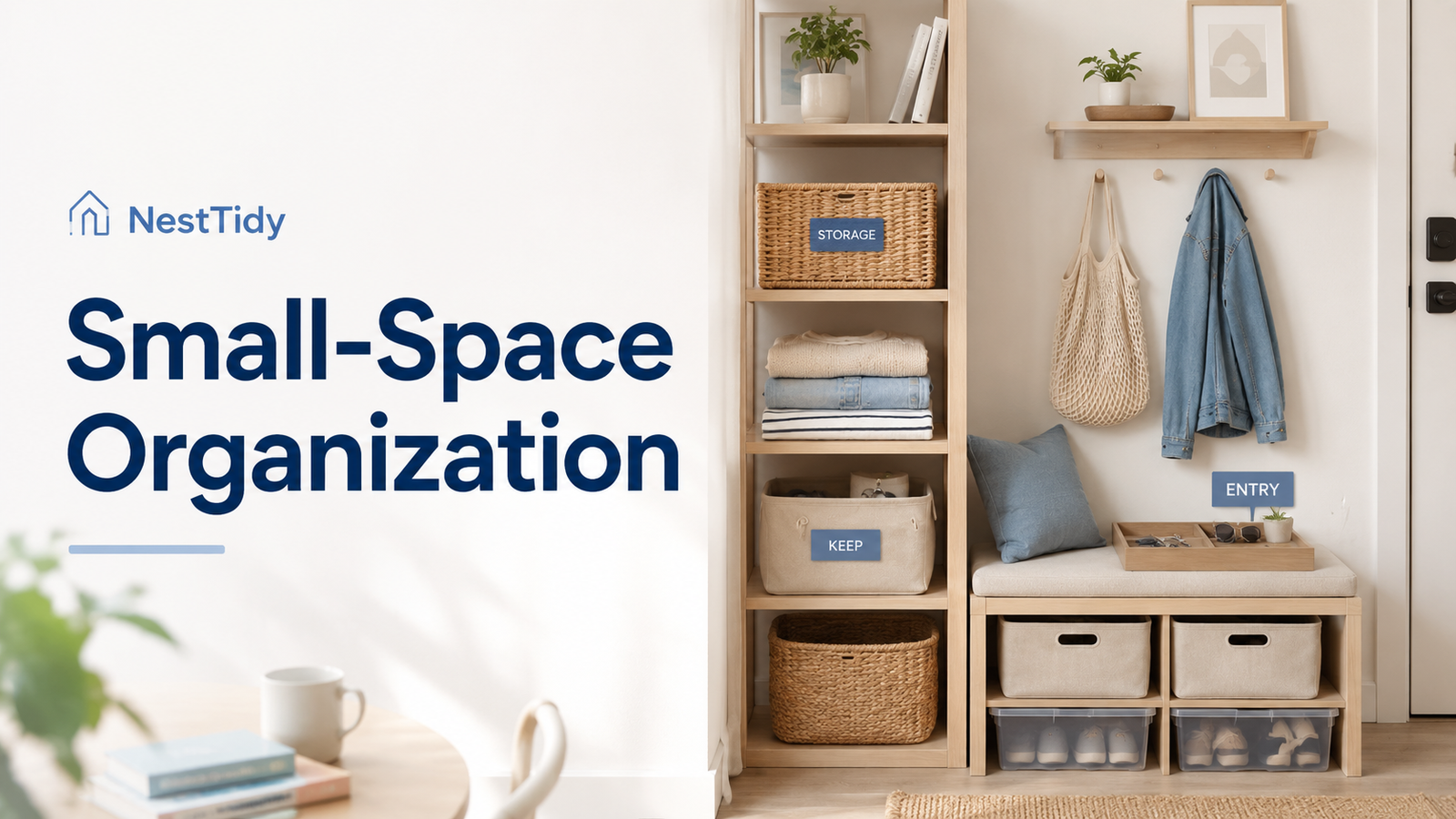
Entryway
- Create one small landing area for keys, wallet, sunglasses, and outgoing items.
- Limit shoes to what is currently in rotation.
- Use wall hooks selectively for coats or bags that are actually used.
- Give mail an immediate next step: recycle, act, or file.
Living Area
- Use furniture with concealed storage for blankets, games, or media when it fits naturally.
- Create one home for remotes and chargers.
- Avoid letting coffee tables become permanent storage surfaces.
- Keep walkways and seating areas free before adding decorative storage.
Small-Home Organization Checklist
Before You Organize
- Choose one problem area instead of trying to reorganize the whole home.
- Remove obvious clutter and duplicates.
- Identify the routine the space needs to support.
- Measure the available space before considering a new storage product.
While You Organize
- Keep daily-use items in the easiest locations.
- Use vertical space only where it improves access.
- Protect counters, desks, tables, and walkways.
- Give each category a clear boundary.
- Prefer flexible storage that can be reused elsewhere.
Before You Buy Anything
- Confirm that the problem still exists after decluttering.
- Check exact width, depth, height, and clearance.
- Decide what specific category the product will hold.
- Check whether something you already own can solve the problem.
- Ask whether the new item will make the room easier to use, not simply fuller.
Common Small-Space Organization Mistakes
1. Using Every Inch of Space
Efficient storage does not mean filling every available surface, wall, shelf, and gap. Some empty space is useful for movement, visual calm, and future changes.
2. Buying Organizers Before Decluttering
If the category is too large, a better container may only hide the real problem. Reduce first, then decide whether storage is actually needed.
3. Putting Too Much on the Walls
Vertical storage is valuable, but too many open shelves, hooks, and racks can make a compact room feel more crowded.
4. Making Storage Hard to Reset
A system that requires lifting three boxes to reach one item is unlikely to stay organized. Everyday storage should be easy to open, use, and close.
5. Ignoring Door and Drawer Clearance
An organizer can fit the measured space and still prevent a door, drawer, cabinet, or nearby appliance from opening properly. Measure the movement around the storage too.
6. Choosing Aesthetics Over Routine
Matching bins are not helpful if the people using the space cannot see, reach, or return the contents easily.
7. Turning Every Problem Into a Purchase
Sometimes the best small-space solution is removing a category, relocating it, or changing the routine rather than buying another product.
Frequently Asked Questions
How do I organize a small home with very little storage?
Start by reducing what you do not use, then reserve the easiest storage locations for everyday items. Use selected vertical, under-bed, door, and high-shelf space for categories that benefit from it, while keeping walkways and work surfaces clear.
Should I use open or closed storage in a small room?
Use whichever makes the routine easier. Closed storage is helpful for visually mixed categories, while open storage works well for frequently used items that stay reasonably tidy. A small room usually benefits from a balance of both.
What should I organize first in a small apartment?
Start with the area causing the most daily friction, such as an entryway, kitchen counter, bathroom cabinet, or closet. Choose one clearly defined space that you can finish instead of reorganizing the entire apartment at once.
Is vertical storage always a good idea for small spaces?
No. Vertical storage can free floor and cabinet space, but too much visible storage can make a room feel crowded. Use it where it improves function and leave some walls visually quiet.
How can I organize a small home without spending much money?
Declutter first, reuse containers that already fit the space, reorganize by routine, and move low-frequency items out of prime storage. Buy a new organizer only when a specific problem remains and you know the required dimensions.
How do I keep a small home from becoming cluttered again?
Give common categories clear limits, make frequently used items easy to put away, protect key surfaces from becoming permanent drop zones, and do small resets before clutter spreads into multiple rooms.
Make the Space Easier to Use, Not Just Fuller
A well-organized small home is not the one that stores the greatest number of things.
It is the one where everyday routines require less moving, searching, stacking, and rearranging.
Start with the biggest point of friction. Reduce what does not need to be there. Use the best storage locations for the things you actually use. Then add a product only when it solves a problem that still exists.
That approach keeps a small home functional without turning every available inch into storage.