How to Declutter Your Home Without Getting Overwhelmed: A Simple Step-by-Step Plan
Decluttering sounds simple until you actually look around and realize there are drawers, closets, countertops, cabinets, shelves, and entire rooms competing for your attention.
That is usually where the problem starts.
Instead of choosing one manageable task, you begin thinking about the whole house. The project suddenly feels too big, so you either put it off or start pulling things out everywhere and create even more mess.
There is a simpler way.
You do not need to declutter your entire home at once. You need to complete one small decluttering loop at a time.
Choose one area. Make a few clear decisions. Put back what belongs there. Remove what does not. Then stop.
Once you can repeat that process, decluttering becomes much easier to manage.
Key Takeaways
- Start with one small area you can completely finish.
- Make the easiest decisions first instead of beginning with sentimental items.
- Declutter before buying bins, baskets, or other organizers.
- Do not leave donation bags and relocation piles sitting around the house.
- Finish one area before opening another.
Table of Contents
- Why Decluttering Feels So Overwhelming
- Don’t Start With Your Whole House
- Step 1: Choose One Area You Can Actually Finish
- Step 2: Remove the Easy Decisions First
- Step 3: Sort What’s Left
- Step 4: Decide What Deserves the Space
- Step 5: Put Back Only What Stays
- Step 6: Get the Decluttered Stuff Out
- Step 7: Stop When the Area Is Finished
- What Should You Declutter First?
- A Simple Decluttering Checklist
- Common Decluttering Mistakes to Avoid
- How to Keep Clutter From Coming Back
- Frequently Asked Questions
Why Decluttering Feels So Overwhelming
The clutter itself may not be the biggest problem.
The real problem is often the size of the project you have created in your head.
“Declutter the house” is not a useful task.
It could mean dealing with hundreds or thousands of objects across multiple rooms, each requiring a different decision.
Compare that with:
“Declutter the top kitchen drawer.”
Now you know exactly where to start, what you are working on, and when you are finished.
That difference matters.
The goal is to make the project smaller before you try to make the clutter smaller.
You may also feel stuck because you are trying to solve too many problems at once.
You are deciding what to keep. You are deciding where things belong. You are wondering whether you need more storage. You are thinking about what could be sold. You are deciding where donations should go.
And somewhere in the middle of all that, you discover an old box of photos and spend the next hour looking through it.
A better system separates those decisions and keeps the session focused.
Don’t Start With Your Whole House
A whole-house decluttering project sounds productive, but it is usually too broad to be useful as a starting point.
Start with something you can realistically finish.
- one drawer
- one kitchen cabinet
- one bathroom shelf
- one section of a closet
- one nightstand
- one small countertop
- one basket
- one shelf in a pantry
Your first goal is not to make a dramatic transformation.
Your first goal is to complete the process from beginning to end.
That gives you something far more useful than a half-finished room: a repeatable system.
Quick Tip
Never open more clutter than you can close before the end of the session.
If you have 20 minutes, do not empty an entire closet. Choose one shelf. If you have an hour, you may be able to handle a small cabinet or one section of a wardrobe. Match the size of the project to the time and energy you actually have.
Step 1: Choose One Area You Can Actually Finish
Pick a clearly defined space.
Not “the kitchen.” Choose “the drawer next to the stove.”
Not “the bedroom.” Choose “the nightstand.”
A good starting area has visible boundaries. You should be able to point to it and know exactly what is included and what is not.
Before starting, ask yourself:
- Can I finish this area today?
- Do I have enough time to put everything back?
- Can I remove trash and donations before I stop?
If the answer is no, make the area smaller.
There is no prize for choosing a difficult starting point.
Finishing a small project is more useful than starting a large one.
Step 2: Remove the Easy Decisions First
Do not begin by asking difficult questions about every object.
Start with the obvious things.
Look for:
- trash
- broken items you will not repair
- empty packaging
- expired products
- obvious duplicates you do not use
- things that clearly belong in another room
- items you already know you no longer want
These decisions require less mental effort and quickly reduce the amount of stuff you still need to evaluate.
You are creating breathing room before making harder decisions.
Avoid sentimental items at the beginning if they tend to slow you down.
Old letters, photographs, children’s keepsakes, gifts, inherited objects, and memorabilia can require more thought. They can wait.
Build momentum with simpler decisions first.
Step 3: Sort What’s Left
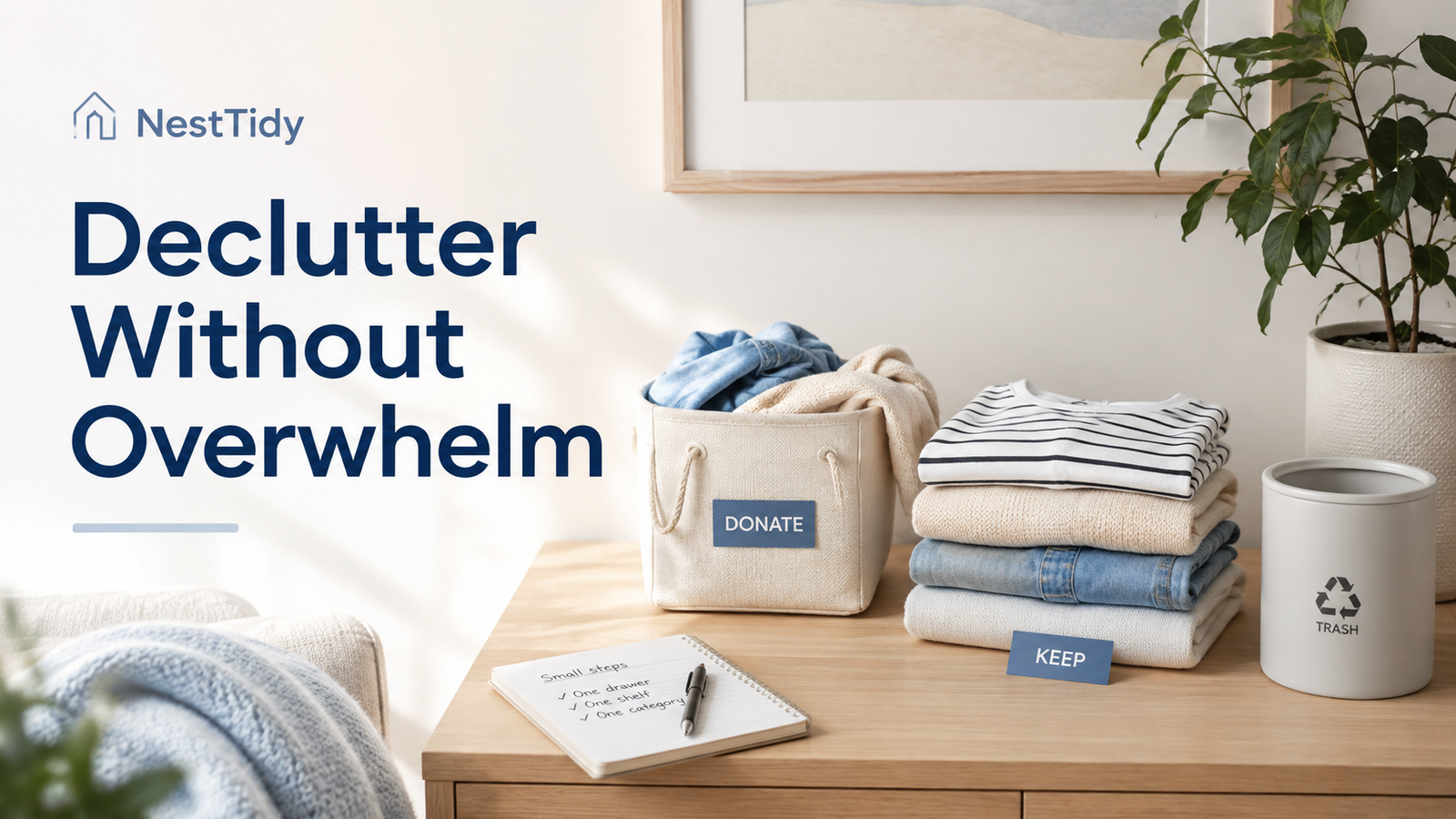
Once the obvious clutter is gone, sort the remaining items into a few simple groups.
You do not need ten categories.
For most areas, these are enough:
Keep
Items you use, need, or intentionally want in your home.
Donate
Useful items you no longer need but someone else could use.
Sell
Items that may realistically be worth the time required to photograph, list, communicate with buyers, and complete the sale.
Relocate
Items you want to keep but that belong somewhere else.
Trash or Recycle
Items that are no longer usable or appropriate to donate.
Be careful with the “maybe” category.
A temporary undecided box can be useful during a difficult project, but if every decision becomes “maybe,” you have simply created a new storage problem.
When possible, make the decision while the item is already in your hand.
Step 4: Decide What Deserves the Space
Decluttering is not only about deciding whether an object is useful.
You are also deciding whether it deserves the space it occupies.
That is especially important in small homes, apartments, kitchens, bathrooms, and closets where storage is limited.
Ask:
- Do I actually use this?
- Would I buy it again today?
- Do I already own something that does the same job?
- Is it easy to replace if I ever need it again?
- Does it fit the way I use this space?
- Am I keeping it because I need it or because I feel guilty getting rid of it?
You do not need to become a minimalist.
The goal is not to own as little as possible.
The goal is to make the space work for your real life.
A kitchen cabinet should make cooking easier. A closet should make getting dressed easier. A bathroom drawer should help you find what you use.
If the storage space is constantly overflowing, the problem may not be the container. There may simply be too many categories or too many items competing for the same space.
Step 5: Put Back Only What Stays
Once you know what you are keeping, return those items to the space.
This is where many people make an expensive mistake.
They start shopping for organizers before they know what actually needs to be organized.
Do not do that yet.
First, see how the space works with fewer items.
You may discover that you do not need another basket, drawer divider, shelf, or set of matching containers.
Use what you already have whenever it works.
If the remaining items still need better organization, you can evaluate storage later based on the actual dimensions and problem.
That is very different from buying containers first and then trying to find things to put inside them.
Declutter first. Organize second. Buy only if needed.
Step 6: Get the Decluttered Stuff Out
This is one of the most important parts of the entire process.
A bag labeled “Donate” is still clutter if it sits in the hallway for three months.
A box of things you plan to sell is still taking up space.
A pile labeled “belongs upstairs” is still a pile.
Complete the loop.
Trash
Put it in the trash.
Recycling
Move it to the correct recycling location.
Relocate
Return the item to the room or storage area where it belongs.
Donate
Place donations somewhere connected with leaving the house, not returning to storage. Depending on your routine, that may be near the door, in the garage, or directly in your car. Then choose when you will actually drop them off.
Sell
Be realistic. Selling something requires time. If an item is worth very little and may sit in a “sell someday” box for six months, donating it may give you more value than the potential money.
You do not need to maximize the financial return on every object leaving your home. Sometimes reclaiming the space is the return.
Step 7: Stop When the Area Is Finished
Finishing one area can create a burst of motivation.
That is useful, but it can also lead to a common mistake.
You finish one drawer. Then you open the cabinet next to it. Then the pantry. Then you decide to reorganize the refrigerator.
Two hours later, four areas are partially finished and the kitchen looks worse than when you started.
Instead, complete the first area.
Remove everything that needs to leave. Put away the items that stay. Then stop.
If you still have time and energy, choose another clearly defined area and begin a new decluttering loop.
Treat each area as its own project.
What Should You Declutter First?
If you do not know where to begin, start with items that require the least emotional decision-making.
- Obvious trash
- Expired or unusable items
- Broken items you will not repair
- Things that belong somewhere else
- Obvious duplicates
- Items you clearly do not use
- Easy donations
- Clothing
- Books and hobby supplies
- Sentimental items and keepsakes
You do not need to follow this order perfectly.
The principle is more important than the list: start with easier decisions and build confidence before tackling difficult categories.
A Simple Decluttering Checklist
Before You Start
- Choose one clearly defined area.
- Make sure you have enough time to finish it.
- Prepare a trash bag and donation bag if needed.
- Avoid opening nearby drawers, cabinets, or boxes.
While Decluttering
- Remove obvious trash first.
- Move misplaced items into a relocation group.
- Identify easy donations.
- Look for duplicates.
- Decide what genuinely needs to stay.
- Avoid creating a large “maybe” pile.
- Do not shop for organizers yet.
Before You Finish
- Put back the items you are keeping.
- Return relocated items to their proper places.
- Take out the trash.
- Prepare donations to leave the house.
- Decide whether anything truly needs additional storage.
- Stop before beginning another area.
Common Decluttering Mistakes to Avoid
1. Starting With an Entire Room
“Declutter the bedroom” is usually too broad. Start with one drawer, shelf, or section.
2. Pulling Everything Out at Once
Emptying an entire room can work for some projects, but it can also create unnecessary pressure. For everyday decluttering, work in smaller sections you can fully complete.
3. Organizing Before Decluttering
A neatly arranged collection of things you do not need is still clutter. Reduce first. Organize what remains.
4. Buying Storage Too Early
Storage products can help, but they should solve a specific problem. Do not buy a container simply because it looks useful. Measure the space and understand what actually needs to go there first.
5. Creating a Permanent “Maybe” Pile
A small undecided category is sometimes useful. A permanent collection of items you never make decisions about is not. Set a limit on how much you allow into the maybe category.
6. Leaving Donations in the House
Decluttering is not finished when you move something from a cabinet into a bag. The item needs to leave the home.
7. Moving Clutter From One Room to Another
Relocation should have a destination. Do not create another pile somewhere else.
8. Starting With Sentimental Items
Sentimental objects often require more time and emotional energy. Start with easier categories and save difficult decisions for later.
How to Keep Clutter From Coming Back
Give Frequently Used Items a Home
If you regularly find the same objects on counters, tables, or chairs, look at where they actually need to live.
The best storage location is often the one that matches how you already use the space.
Watch What Comes Into the House
Decluttering becomes much easier when you reduce unnecessary incoming purchases.
Before buying something for your home, ask:
- Where will it go?
- What problem does it solve?
- Do I already own something similar?
- Would I still want it if it were not on sale?
Use the Limits of the Space
A drawer, shelf, cabinet, or closet has a physical limit.
Instead of constantly expanding storage, consider letting the available space determine how much of a category you keep.
If the shelf comfortably holds ten towels, adding another shelf may not be the first solution. You may simply need fewer towels.
Do Small Resets
You do not need another major decluttering project every month.
Small resets are easier.
A drawer while dinner is cooking. A bathroom shelf before your shower. One section of the closet on a Saturday morning.
The goal is not to keep your home perfect.
The goal is to prevent small amounts of clutter from turning into another overwhelming project.
Frequently Asked Questions
Where should I start decluttering if my whole house is messy?
Start with one small, low-emotion area that you can completely finish. A junk drawer, bathroom shelf, kitchen cabinet, or small countertop is usually better than starting with an entire room.
How long should I declutter each day?
There is no required amount of time. Even 10 or 20 focused minutes can be useful if you choose a project small enough to finish. Match the size of the task to the time you actually have.
Should I buy organizers before I declutter?
Usually, no. First remove what you no longer need and see how the remaining items fit the space. If you still have a specific storage problem afterward, measure the area and choose a solution that fits it.
What if I have trouble getting rid of things?
Start with easy decisions. Trash, expired items, obvious duplicates, and things you clearly no longer use can help you build momentum. Leave sentimental or emotionally difficult categories for later.
What should I do with things I want to sell?
Only create a sell category for items you realistically intend to list soon. If something has little resale value or will probably sit in a box for months, donating it may be the simpler option.
How do I declutter without making a bigger mess?
Work on one small area at a time and do not open another space until the first one is completely finished. Put away what stays and remove trash, donations, and relocated items before ending the session.
Start Smaller Than You Think You Need To
You do not need a free weekend, dozens of storage bins, or a perfectly organized plan to start decluttering.
You need one small area and enough time to finish it.
Pick a drawer. Clear one shelf. Deal with one cabinet.
Complete the entire loop before moving on.
Then repeat.
A more functional home is rarely created in one dramatic weekend. It is usually built one completed space at a time.