Orchid Care After Blooming: What to Do When the Flowers Fall
The last orchid flower has fallen. That does not mean the plant is finished. For a common Phalaenopsis (moth orchid), this is a good moment to inspect the flower spike, check the roots, and give the plant conditions that support its next growth cycle. Here is a calm, practical routine for orchid care after blooming.
Goal
Keep the plant healthy after flowering
Time
10 min to check; ongoing care
Difficulty
Beginner-friendly
Best For
Indoor Phalaenopsis
Quick Answer
When a moth orchid finishes flowering, check its spike. Cut a fully dry, brown spike close to the base. If the spike is still green and the plant is strong, you may leave it alone or trim just above an unused healthy node; a side shoot is possible, not certain. Keep the plant in bright, indirect light, water when its mix is nearly dry, and drain it fully. If the plant is weak, prioritize root and leaf health over another round of flowers.
Before You Start
This guide is for the common indoor Phalaenopsis hybrid. If your label says Dendrobium, Cymbidium, Oncidium, or something else, check advice for that type before cutting its spike. Have clean scissors, access to the inner nursery pot, and a bright place to examine the plant.
01
Check the Flowers, Spike, and Plant
Look at the whole plant before reaching for scissors.
Spent flowers dropping after a long display are normal. Check whether the spike is green and firm or fully brown and dry. Then look at the leaves and roots. Firm leaves and living roots suggest a plant that can support new growth; soft, hollow roots or limp leaves call for care first.
If unopened buds are turning yellow and dropping, that is a different problem. Sudden changes in temperature, drafts, root stress, poor light, or nearby ripening fruit can contribute. Check the conditions rather than automatically adding more water.
Done when: you can describe the spike and have checked the leaves and roots.
02
Choose What to Do With the Old Spike
Green and brown spikes need different decisions.
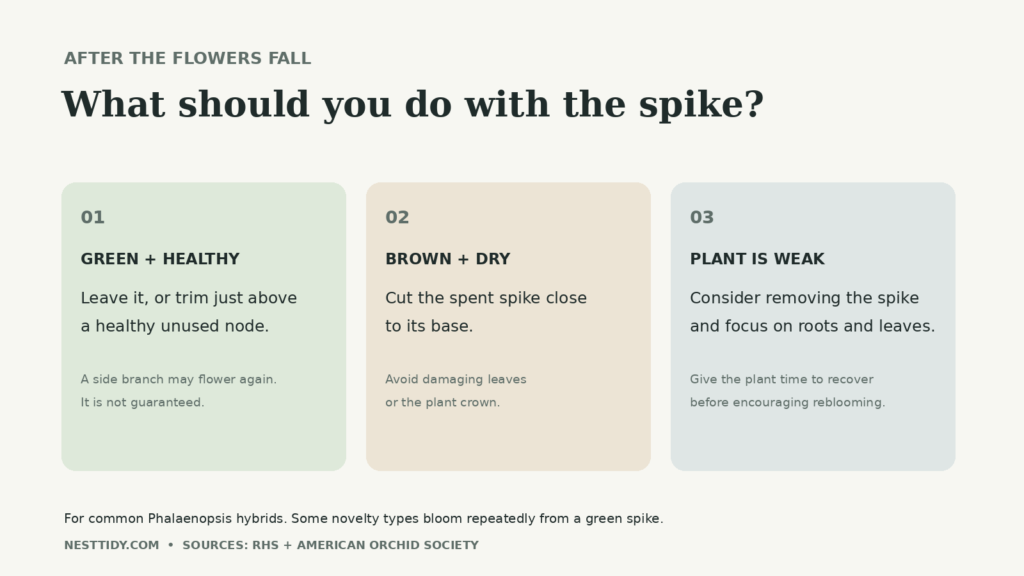
- Brown and dry: use clean scissors to cut the spent spike close to its base, without nicking the leaves or crown.
- Green and healthy: leave it intact, or trim just above a healthy, unused node lower on the spike (often above the second node). A flowering side branch may form, but it is not guaranteed.
- Partly brown spike: if the tip has dried but the lower stem is green, trim the dead section above a healthy unused node, or remove the entire spike if you prefer to let the plant recover.
- Weak plant: removing the spike near the base can help you prioritize healthy roots and leaves over a second flowering. A new spike may take longer.
A node is a small joint or bump on the spike. Use clean scissors and cut above it, not through it. Avoid cutting into the leaves or the crown. Some novelty Phalaenopsis repeatedly flower from the tip of a green spike; leave those spikes intact if you know you have one. There is no single cut that guarantees reblooming.
Done when: the spike decision matches both its condition and the health of the plant.
03
Give It Enough Gentle Light
Future flowers depend on a healthy growing plant.
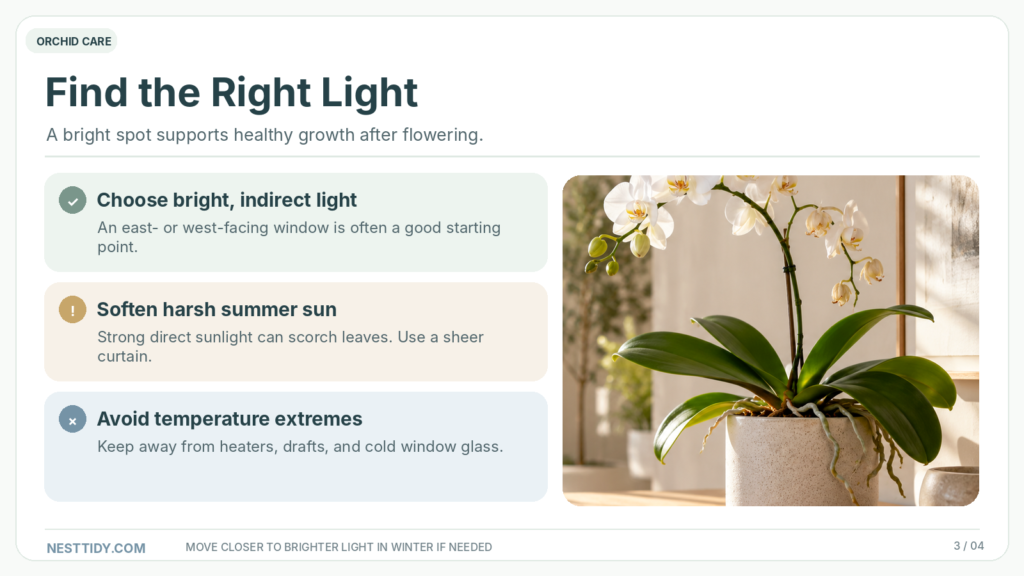
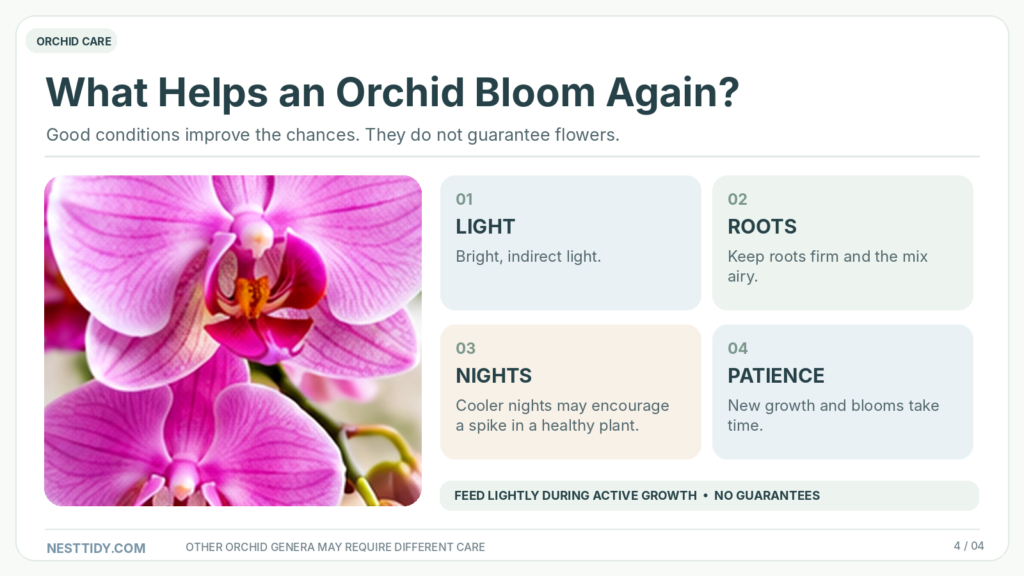
Place your orchid where it receives bright, indirect light. An east-facing window is often a useful starting point; a bright west or south window may need a sheer curtain or distance from strong sun. Windows vary with season, trees, and neighboring buildings, so watch the plant rather than relying on compass direction alone.
A Phalaenopsis can keep its leaves in a dim room yet fail to flower again. If it is healthy but has not produced a new spike, try a brighter location without exposing the leaves to scorching direct sun.
Done when: the plant has a bright spot with protection from harsh sun.
04
Water According to the Mix, Not the Calendar
Check the pot before each watering.
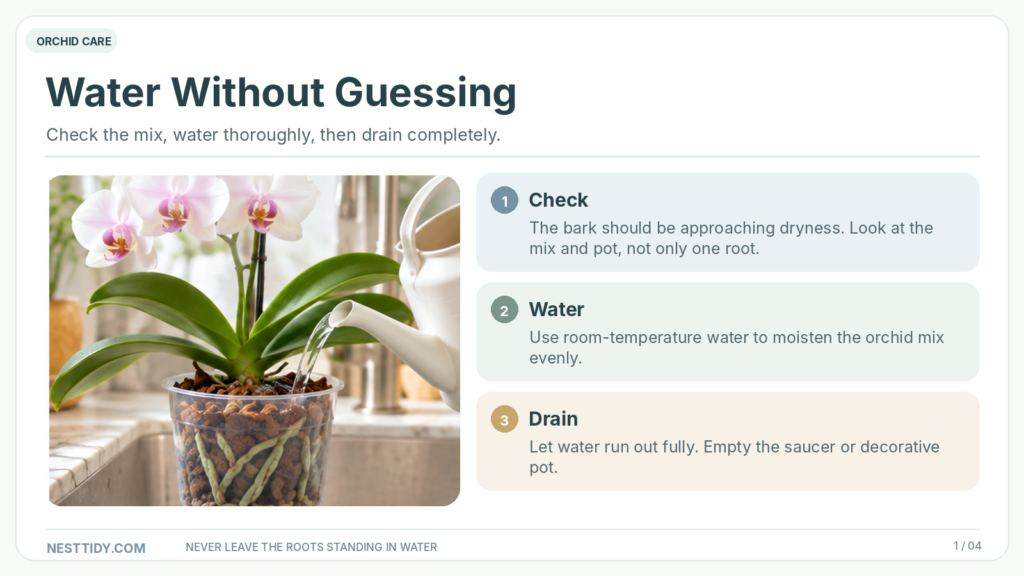
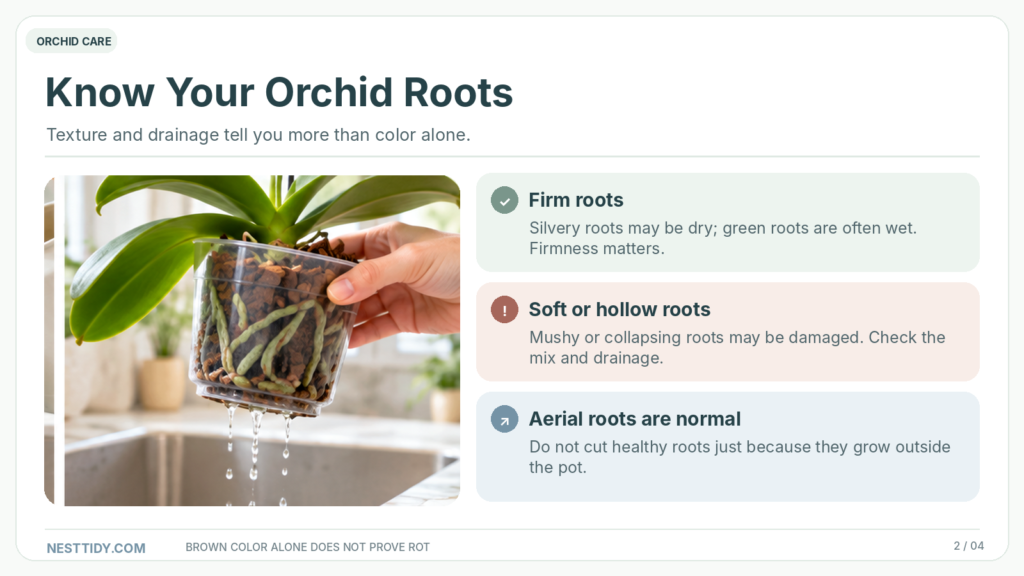
Feel the mix below its surface, look at the roots through a clear pot if you have one, and notice the pot weight. Silvery roots can suggest that watering is approaching; green roots are often moist. Use these clues together. Bark, moss, pot size, light, and room temperature all affect drying time.
When the mix is nearly dry, take the inner pot out of its decorative cover and water thoroughly with lukewarm water. Let water run through the pot and drain completely before returning it. Empty the saucer or cover pot. If water collects where the leaves meet in the crown, blot it away. Do not leave the roots sitting in water; do not let them dry out for a prolonged period either.
A weekly check can be convenient, but “every Sunday” is not a reliable watering rule. Misting cannot replace watering the roots inside the pot.
Done when: you have checked moisture and the drained pot is not standing in water.
05
Inspect the Roots and Bark
Repot only when the growing mix or roots call for it.
Aerial roots growing outside the pot are normal. Healthy roots are generally firm, whether silvery, green, or paler inside the mix. Clearly mushy or hollow roots need attention. Bark that has broken down, stays soggy, or drains poorly can contribute to root problems.
If repotting is needed, choose an airy bark-based orchid mix and a pot with drainage holes. Remove old mix gently, trim only clearly dead roots with clean scissors, and keep the crown above the mix. Avoid dense all-purpose potting soil and a pot much larger than the root system. Repotting is often needed around every couple of years, or sooner if the mix is failing.
Done when: the roots and drainage are sound, or you have a plan to refresh a failing mix.
06
Feed Lightly While It Is Growing
Fertilizer supports growth; it cannot replace light or roots.
During active growth, use an orchid fertilizer according to its label. One conservative routine from University of Maryland Extension is to feed every third or fourth watering. Occasionally water without fertilizer to flush salts from the mix, and reduce or skip feeding during low-light winter conditions when growth is slow.
If the roots are damaged, fix the watering or mix first. Extra fertilizer will not force a weak plant into bloom.
Done when: feeding follows active growth and the product label.
07
Help a Healthy Orchid Flower Again
Start with light and patience, then consider a modest temperature change.
If a mature, healthy Phalaenopsis has not flowered for a while despite good light and roots, the Royal Horticultural Society suggests moving it to a place about 5°C (8°F) cooler for roughly a month to encourage a new spike. Keep it away from cold drafts, freezing glass, heating vents, and abrupt temperature swings, especially once buds form.
A green side branch from an old spike may flower sooner, while a fresh spike from the plant takes longer. Neither happens on a guaranteed schedule. New roots or leaves are useful signs that the plant is growing, even when no flowers are visible yet.
Done when: you are supporting healthy growth and have realistic expectations for new blooms.
Mistakes to Avoid
- Assuming fallen flowers mean a dead orchid: look at leaves and roots.
- Cutting every green spike at once: some can form a side shoot; novelty types may rebloom from the tip.
- Leaving a pot in standing water: let it drain completely.
- Using dense ordinary potting soil: Phalaenopsis roots need an airy orchid mix.
- Moving a budding plant between hot and cold spots: sudden changes can cause bud drop.
- Adding more fertilizer to solve every problem: check light and roots first.
FREE PDF GUIDE
Keep Your Orchid Care Guide Handy
Want a simple reference for your orchid after the flowers fall? Download our free illustrated guide to caring for common Phalaenopsis orchids, with practical advice on flower spikes, watering, healthy roots, light, and encouraging future blooms.
Free PDF. No sign-up required. Open it to view or save a copy.
Frequently Asked Questions
Should I cut the orchid stem after flowers fall?
For a common Phalaenopsis, cut a completely brown, dry spike near its base. A healthy green spike can be left alone or cut just above a healthy unused node if the plant is strong. Some novelty types should retain their green spike.
How long before an orchid blooms again?
There is no reliable date for every plant. A side shoot can appear on an existing green spike, while a new spike needs more growth time. Light, plant health, and temperature all affect the result.
Should I water more after flowering?
No automatic increase is needed. Check the mix and water when it is nearly dry, then let the pot drain fully.
Are aerial roots a sign that the orchid needs a bigger pot?
Not on their own. Aerial roots are normal for Phalaenopsis. Repot when the mix deteriorates, drainage is poor, or the plant has outgrown its container.
Why are my orchid leaves wrinkled?
The plant may be unable to take up enough water because the mix is too dry or because roots have been damaged in a wet mix. Check the roots and moisture before changing your watering routine.
What if the buds fall before opening?
Bud drop can have several causes, including temperature swings, drafts, under- or overwatering, low light, and ethylene from ripening fruit. Review the growing conditions rather than assuming one cause.
Your Next Orchid Check
Start by checking whether the old spike is green or fully dry. Then look at the roots and growing mix before deciding whether to water. Keep the plant in bright, indirect light and give it time to grow. A healthy orchid can bloom again, but there is no guaranteed schedule or special cut that makes it happen.
For a longer illustrated reference, read the NestTidy Orchid Care Guide (PDF). You can also explore the specialist references below.
Sources and Further Reading
- Royal Horticultural Society: How to grow Phalaenopsis
- American Orchid Society: Phalaenopsis Culture Sheet
- American Orchid Society: Where do I cut the spike?
- University of Maryland Extension: Care of Phalaenopsis Orchids
- American Orchid Society: Bud Blast
This article focuses on commonly sold Phalaenopsis hybrids. Growing conditions and responses can vary by plant and home.