
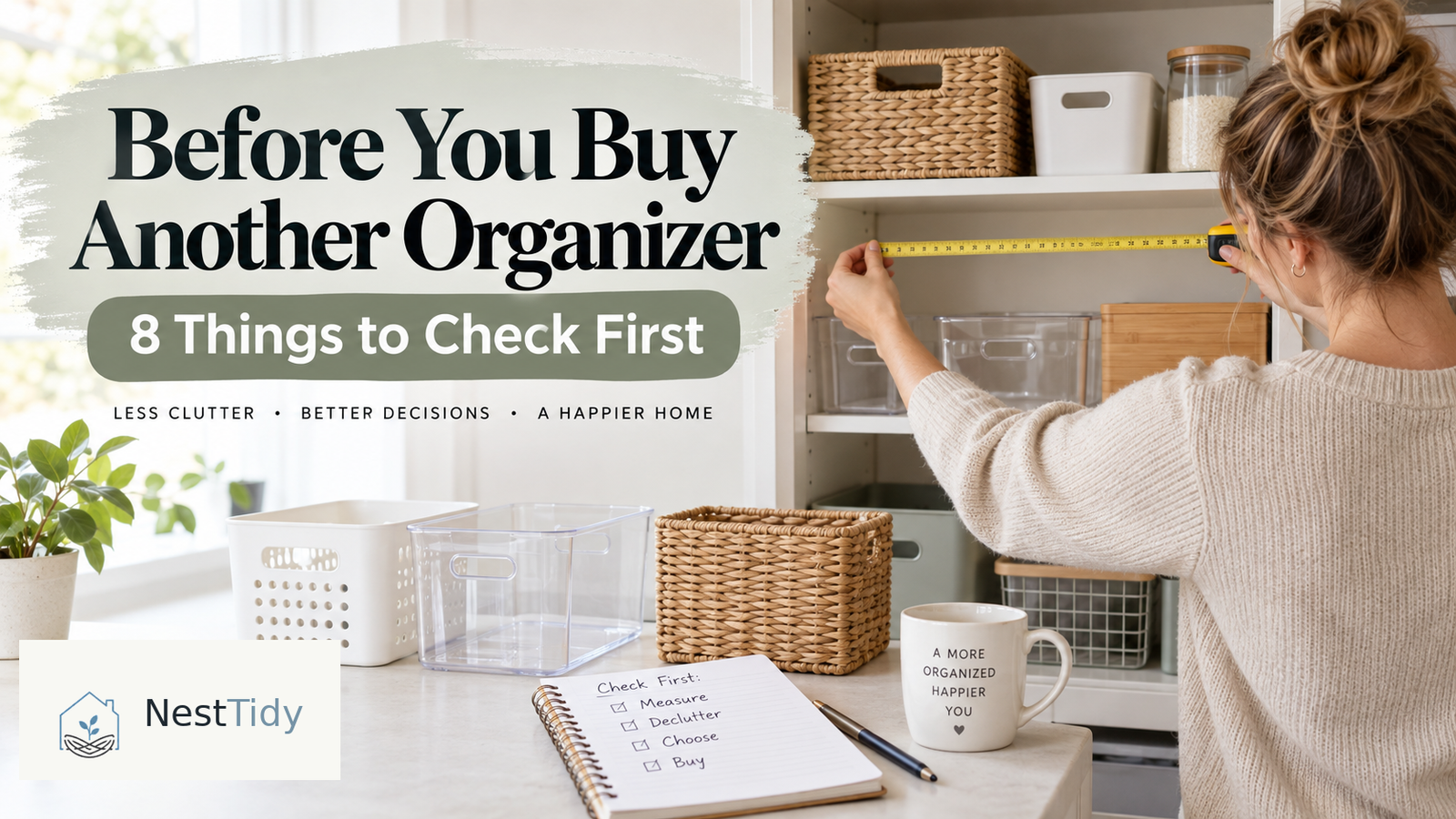
Before You Buy Another Organizer: 8 Things to Check First
Organizers are supposed to make life easier. But it is surprisingly easy to buy a bin, basket, drawer insert, turntable, shelf riser, or storage box and realize a week later that it does not actually help. Before you buy another organizer, work through these eight checks first. By the time you finish, you should know whether you actually need one and, if you do, exactly what kind of organizer will make the space work better.
Goal
Buy only what solves a real problem
Time
15–30 min to evaluate
Difficulty
Easy
Best For
Bins, baskets, inserts, risers
Why Buying the Organizer First Usually Backfires
Storage products are easy to buy because they feel like progress. A cluttered cabinet can make a new set of bins look like the obvious solution. A messy bathroom drawer can make an insert seem essential. A crowded shelf can make another basket feel useful.
But buying first often means designing the system around the organizer instead of around the things you actually use.
- Containers can waste shelf space.
- Deep bins can make everyday items harder to reach.
- Lids can add unnecessary steps.
- Opaque baskets can hide things you need to see.
- Organizers can end up storing items you should have decluttered first.
The organizer should solve a problem that you have already identified. It should not be the starting point.
Quick Answer
Before buying an organizer, follow this order:
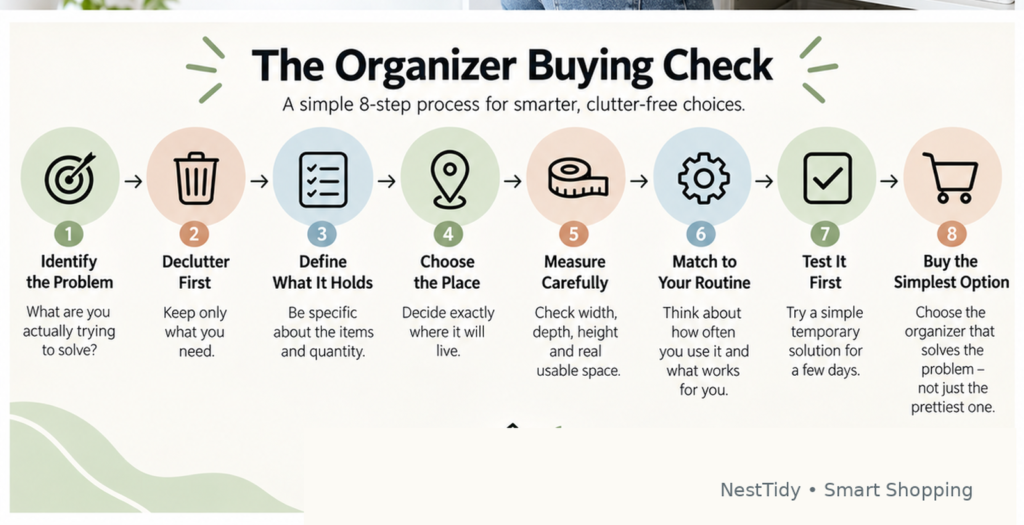
Identify the problem → Declutter → Define what it will hold → Choose the location → Measure → Match it to your routine → Test the system → Buy last
If you cannot clearly explain what the organizer is supposed to fix, you probably do not need to buy it yet.
Before You Start
Do not open a shopping app yet. Instead, choose one area that is frustrating you, such as a kitchen cabinet, bathroom drawer, closet shelf, entryway, pantry, under-sink cabinet, desk drawer, or linen closet.
Then ask one simple question: What exactly is not working here? Try to answer that before looking at products.
01
Name the Problem You Are Actually Trying to Solve
Start with the problem, not the product.
A messy space can have several different causes. You might think you need an organizer when the real problem is too many items, no clear categories, poor placement, difficult access, wasted vertical space, items falling over, small things getting lost, or no permanent home for frequently used items.
Be specific. “Bathroom storage is bad” is too vague. “Small skincare products keep falling behind larger bottles” gives you something useful to solve.
Done when: you can explain the problem in one sentence without mentioning a product.
02
Declutter Before You Measure
Do not design storage for things you may not keep.
Remove empty packages, expired products, duplicates, broken items, things you never use, and items that belong somewhere else.
This matters because clutter changes the size of the problem. A shelf that looks like it needs three bins may only need one after you remove what does not belong there.
Done when: only the items you genuinely want to keep remain in the space.
03
Decide Exactly What the Organizer Will Hold
Define the category before choosing the container.
Do not buy “something for the closet.” Decide what the container is actually for: scarves, cleaning cloths, extra toiletries, kids’ snacks, charging cables, baking supplies, food container lids, winter gloves, or another clearly defined category.
Then look at the quantity. The category and amount should determine the storage, not the other way around.
Done when: you know exactly what category will live inside the organizer and roughly how much space it requires.
04
Choose Where It Will Live
The location comes before the product.
Think about where the items are used and how often you need them. Everyday items should usually be easy to reach. Occasional items can live higher up, deeper in a cabinet, or farther away.
- Where do I use these things?
- Where do I naturally put them down?
- Will everyone in the household know where they belong?
- Can I reach the organizer without moving several other things?
NestTidy Tip
If people keep leaving an item somewhere other than its assigned home, the location may be the problem, not the habit.
Done when: the category has a practical home that matches how it is actually used.
05
Measure the Usable Space, Not Just the Shelf
Measure how the space actually works.
Do not stop at width, depth, and height. Look for hinges, pipes, door frames, baseboards, shelf lips, drawer tracks, sloped walls, handles, door swing, and the space needed to pull the organizer out.
Also measure the objects that will go inside. A bin may fit perfectly on the shelf but still be useless if the bottles are too tall or you cannot remove the bin without hitting the shelf above.
Done when: you know both the usable dimensions of the space and the approximate dimensions of the items you want to store.
06
Match the Organizer to How You Actually Use the Items
Choose for access and routine, not just appearance.
Open or closed?
Open bins are often convenient for frequently used items. Closed containers can work well for seasonal or less attractive categories, but lids add another step.
Clear or opaque?
Clear containers make contents easy to see. Opaque containers can reduce visual clutter, but labels may help if you forget what is inside.
Deep or shallow?
Deep bins can hold a lot, but smaller items may disappear at the bottom. Shallow storage often works better for categories you access frequently.
Stackable or easy access?
Stacking saves space, but consider whether you will actually want to move two containers every time you need the bottom one.
Done when: you can explain why the organizer type matches how often and how easily you need to access the items.
07
Test the System Before You Spend
Try the idea with something temporary first.
Create a temporary version with a cardboard box, shoe box, empty food container, spare basket, tray, or container borrowed from another room.
Use it for a few days. Notice whether you can reach everything easily, the category stays together, household members put things back, and the location actually works.
A prettier container will not fix a bad system.
Done when: the temporary setup works during normal everyday use.
08
Buy the Simplest Organizer That Solves the Problem
Shop for one specific solution, not a matching collection.
By this point you should know what you are storing, how much you are storing, where it will live, the usable dimensions, how often you need access, whether visibility matters, whether stacking makes sense, and whether the system already works in practice.
You may discover that you need one shallow bin, one drawer divider, one shelf riser, one basket, one turntable, or one lidded box. Not a complete matching set. Just the simplest product that solves the problem.
Done when: you can describe exactly what the organizer needs to do before you buy it.
Red Flags That an Organizer Is Probably the Wrong Buy
- You are buying it because it is cute.
- You do not know what will go inside.
- You have not decluttered yet.
- You have not measured the space.
- You are buying several sizes “just in case.”
- The system requires moving multiple containers to reach everyday items.
- The organizer creates more storage for things you do not really need.
- You are replacing a working system only because it does not match.
A storage product should make something easier. If you cannot identify what becomes easier, it may not be worth buying.
Mistakes to Avoid
Buying matching sets too early
Matching containers can look great, but they may force different categories into the same size and shape even when those categories have different needs.
Measuring only the furniture
Always measure both the storage space and the items going inside.
Ignoring access
A solution that requires too many steps will often stop working.
Choosing capacity over convenience
The container that holds the most is not always the best choice.
Organizing clutter instead of reducing it
An organizer can make excess stuff look neater, but it does not remove the excess.
Frequently Asked Questions
Should I declutter before buying organizers?
Yes. Decluttering first helps you understand how much storage you actually need and prevents you from buying containers for things you may decide not to keep.
Are clear bins better than opaque bins?
Neither is automatically better. Clear bins are useful when visibility matters. Opaque bins can reduce visual clutter. Choose based on how you use the category and whether you need to see the contents quickly.
How much extra space should I leave around an organizer?
Leave enough room to lift, slide, or pull the organizer out comfortably. Avoid buying something that only fits when pushed tightly against every edge.
Are matching organizers worth it?
They can be useful when several identical spaces or categories have the same needs. But matching storage is not necessary for a functional home.
When is an organizer actually worth buying?
When you have identified a specific storage problem, decluttered the category, chosen the location, measured the usable space, and confirmed that the product will make the system easier to use.
What should I measure before buying storage bins?
Measure the usable width, depth, and height of the storage area, any obstacles such as hinges or pipes, the clearance needed to remove the bin, and the size of the items that will go inside.
Take the Next Useful Step
The goal is not to own the perfect set of organizers. It is to create a home that is easier to use without filling it with more things than you need.
Continue with How to Organize Your Kitchen on a Budget Without Buying More Stuff or How to Create Free Storage Using Things You Already Have.
Final Thought
Organizers can be useful, but they work best when they are the final step, not the first. Declutter. Understand the problem. Choose the location. Measure. Test the idea. Then, if you still need something, buy the simplest organizer that solves the problem.
That small pause before shopping can save money, reduce clutter, and make the system much more likely to last.
